Costs
Deck stair cost
What deck stairs cost per step and per flight, by material, plus the landing and railing costs people leave out of the budget.
Updated
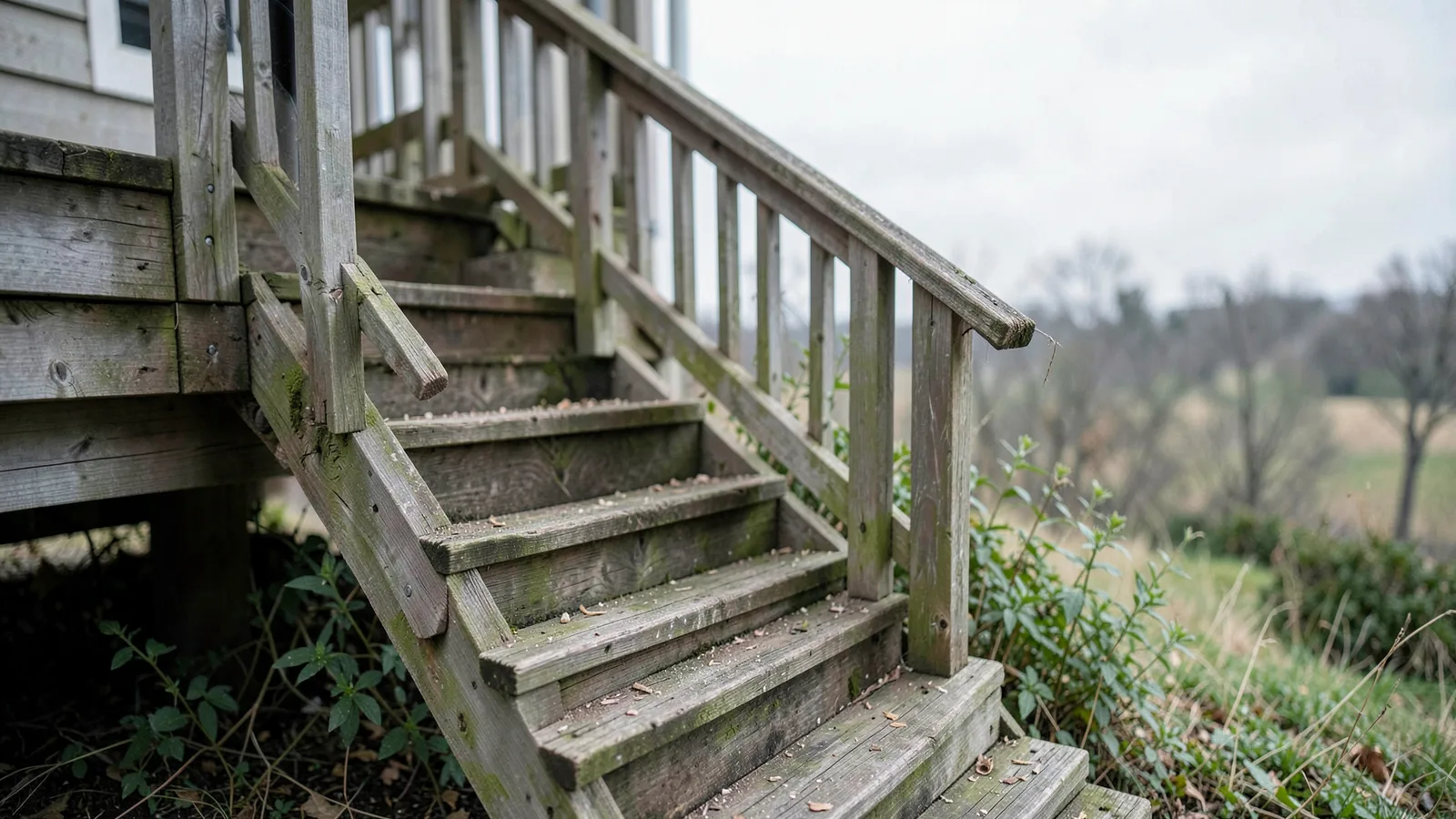
Deck stairs cost $100 to $350 per step installed, with pressure-treated pine landing near $150. A typical five-step flight with a railing runs $900 to $2,200, before the landing.
Stairs are the most expensive part of a deck per square foot, and the reason is that they are structural carpentry rather than surface work. Every step is cut individually, the stringers carry load, and the railing is a code assembly.
Stair Calculator
Calculate riser height, tread count, total run and stringer length from your total rise — checked against IRC, IBC and ADA limits before you cut anything.
What you are paying for
| Component | Share of cost | Notes |
|---|---|---|
| Stringers | 15–25% | 2x12 stock, cut individually; three for a 36 in stair |
| Treads and risers | 20–30% | Where the material choice shows up most |
| Railing and balusters | 25–35% | Required at four or more risers; often the largest single item |
| Landing or footing | 10–20% | Concrete pad or compacted gravel base |
| Hardware and fasteners | 5–10% | Joist hangers, structural screws, post bases |
Cost by material
Installed, per step, for a 36 inch wide stair.
| Material | Per step | Per 5-step flight | Lifespan |
|---|---|---|---|
| Pressure-treated pine | $100 – $200 | $500 – $1,000 | 10–15 yrs |
| Cedar | $150 – $250 | $750 – $1,250 | 15–20 yrs |
| Composite | $200 – $300 | $1,000 – $1,500 | 25–30 yrs |
| PVC | $220 – $350 | $1,100 – $1,750 | 30+ yrs |
| Hardwood (ipe, cumaru) | $250 – $400 | $1,250 – $2,000 | 25–40 yrs |
Add the railing separately: $50 to $120 per linear foot installed, and a five-step flight needs roughly 8 to 10 feet of it on each open side.
Cost by flight size
Pressure-treated, including a basic railing on one side and a gravel landing.
| Deck height | Risers | Riser height | Total run | Typical cost |
|---|---|---|---|---|
| 24 in | 4 | 6 in | 2 ft 7 1/2 in | $600 – $1,400 |
| 36 in | 5 | 7 1/4 in | 3 ft 6 in | $900 – $2,200 |
| 48 in | 7 | 6 7/8 in | 5 ft 3 in | $1,300 – $3,000 |
| 60 in | 8 | 7 1/2 in | 6 ft 1 1/2 in | $1,600 – $3,600 |
| 96 in | 13 | 7 3/8 in | 10 ft 6 in | $2,600 – $5,800 |
A 24 inch deck is the one worth checking by hand. Dividing by a 7 1/4 inch target gives 3.3 risers, and rounding down to 3 produces an 8 inch riser — over the IRC maximum. Four risers at 6 inches is the compliant layout, and it walks better anyway.
The landing is not optional
An exterior stair has to land on something solid. A stair set straight onto soil settles, and once the bottom step drops the riser heights are out of tolerance — which is both a trip hazard and a code failure. Budget $200 to $600 for a concrete pad, or $100 to $250 for a properly compacted gravel base.
What pushes the price up
Riser count. Cost scales almost linearly with steps, and riser count is set by the deck height rather than by choice. A 96 inch deck is thirteen risers — nearly triple a 36 inch deck.
Railing. At four or more risers a handrail is required, and it is frequently a third of the total. Composite and metal railing systems cost considerably more than site-built pressure-treated.
Width. A 36 inch stair needs three stringers; a 48 inch stair needs four, plus wider treads. Going from 36 to 48 inches adds roughly 30 percent.
Turns and landings. An intermediate landing means two flights, two sets of stringers, and a framed platform — it can double the cost of a tall stair. It is sometimes unavoidable: the IRC limits a single flight to 12 feet of rise.
Site conditions. Sloping or soft ground means deeper footings. In a freezing climate the footing has to reach below the frost line, which can mean a 42 inch pier rather than a pad.
Doing it yourself
Deck stairs are one of the more realistic DIY projects, because the materials are cheap relative to the labour and the tooling is a circular saw and a framing square.
| Materials only | Installed | |
|---|---|---|
| 5-step PT flight, no railing | $150 – $250 | $500 – $1,000 |
| 5-step PT flight with railing | $250 – $450 | $900 – $2,200 |
| Gravel landing | $50 – $100 | $100 – $250 |
| Concrete landing pad | $100 – $200 | $200 – $600 |
The part to get right is the layout rather than the cutting. Work out the riser count and the exact riser height before touching a stringer, and measure the total rise between finished surfaces — the finished deck boards at the top and the finished landing at the bottom.
Where the money is worth spending
The landing, every time. It is the cheapest item on the list and the one whose failure puts the whole stair out of tolerance.
Composite treads on a pressure-treated frame, if the deck itself is composite. Treads take the most wear and weather of anything on a deck, and matching them costs far less than composite stringers.
A proper graspable handrail rather than a flat board on edge. It is a common inspection failure, and correcting it afterwards costs more than doing it once.
Prices here are national US ranges for 2026 and are for planning only. Labour rates vary substantially by region — get at least two local quotes.
Common questions
How much do deck stairs cost?
Between $100 and $350 per step installed, with pressure-treated pine near $150. A typical five-step flight with a railing runs $900 to $2,200, and a landing pad adds $200 to $600 on top.
How much does it cost to build stairs to a deck yourself?
Materials for a five-step pressure-treated flight run $250 to $450, including stringers, treads, hardware and a basic railing. The saving over hiring out is roughly two-thirds, and the work is a weekend for someone comfortable with a circular saw.
Why are deck stairs expensive per square foot?
Because they are framing rather than decking. Every step needs cutting, the stringers are structural, the railing is a code-governed assembly, and the whole thing needs a footing or landing underneath. A square foot of stair costs three to five times a square foot of flat deck.
Calculators for this
- Stair Calculator
Calculate riser height, tread count, total run and stringer length from your total rise — checked against IRC, IBC and ADA limits before you cut anything.
Part of our decks guide.
Reviewed by Quban, Construction estimator, on . How these numbers are checked.