Comparisons
Asphalt vs concrete driveway
A direct comparison of asphalt and concrete driveways on cost, lifespan, climate tolerance and repair — and which one is the better buy for your situation.
Updated
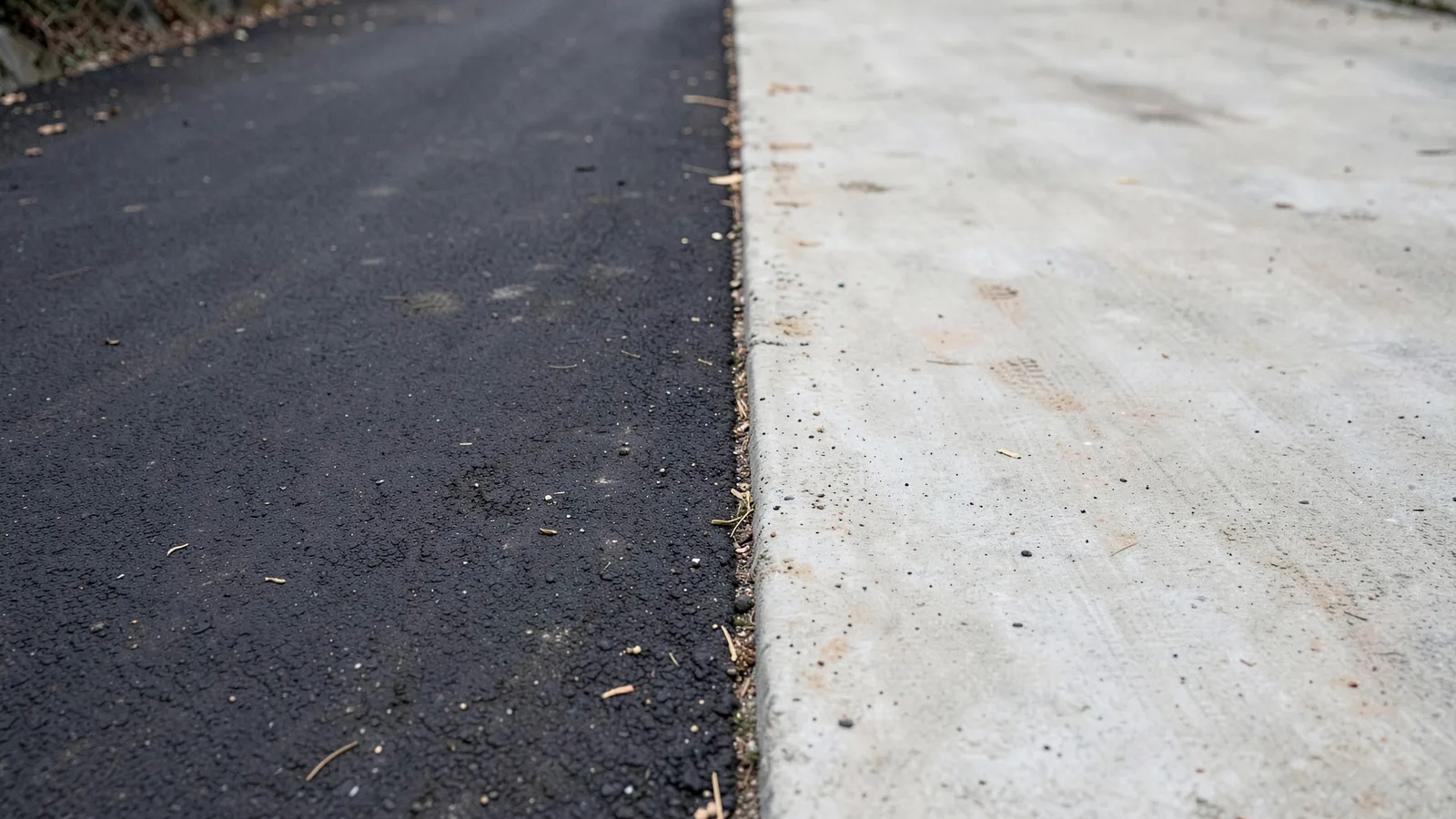
The honest summary: asphalt wins in cold climates and on budget, concrete wins in hot climates and on lifespan. Almost everything else is a detail.
If you are somewhere with hard winters and you want the cheaper option, asphalt is the straightforward answer. If you are somewhere hot, plan to stay two decades, and can absorb the higher up-front cost, concrete is.
Side by side
| Asphalt | Concrete | |
|---|---|---|
| Installed cost | $4–$8 /sq ft | $6–$15 /sq ft |
| Lifespan | 15–25 years | 25–40 years |
| Maintenance | Seal every 3–5 years | Seal every 5 years, otherwise little |
| Usable after install | 24 hours (soft for weeks) | 7 days for cars, 28 for full load |
| Cold climate | Excellent — flexes with heave | Fair — cracks if base is poor |
| Hot climate | Fair — softens, scuffs | Excellent |
| Repairs | Blend seamlessly | Always visible |
| Resurfacing | Yes, ~half of replacement | No — replacement only |
| Appearance options | Black, limited | Colours, stamping, exposed aggregate |
Where the real difference lies
Cold weather. This is the deciding factor for most people. Asphalt is flexible: when the ground heaves in a freeze it moves and settles back. Concrete is rigid, and a rigid slab over ground that moves will crack. Concrete can be built to survive a cold climate, but it needs a deeper base, proper control joints and real drainage — which erodes its cost advantage in longevity.
Heat. The reverse applies above roughly 120°F surface temperature, where asphalt softens. It scuffs when you turn a wheel while stationary, takes kickstand and jack marks, and in sustained heat can rut where cars park in the same spot. Concrete is unaffected, and being light-coloured it stays noticeably cooler.
Repairs. Asphalt repairs blend in — new hot mix bonds to old and, once sealed, the patch is hard to spot. Concrete repairs never disappear: colour and texture always differ. If a section of concrete fails badly, the realistic fix is replacing that whole bay.
Time to use. Asphalt takes traffic the next day. Concrete needs about a week before cars and 28 days to reach design strength. If the driveway is your only access, that matters.
Cost over thirty years
Neither number below is precise — they depend on climate, base quality and how disciplined you are about maintenance — but the shape is right for a 400 sq ft driveway.
| Asphalt | Concrete | |
|---|---|---|
| Installation | $2,400 | $4,000 |
| Sealing (7× at $80) | $560 | $240 (3× at $80) |
| Resurfacing at ~18 years | $1,200 | — |
| 30-year total | ~$4,200 | ~$4,240 |
Over a long enough horizon the two converge. The choice is therefore less about total cost than about when you pay: asphalt spreads it out, concrete demands it up front.
The base matters more than the surface
Whichever you choose, most driveway failures come from the base, not the material on top. Four to six inches of compacted aggregate for cars, eight to twelve where trucks turn or the subgrade is soft clay, and a fall of 1–2% away from the house. A cheap surface on a good base outlives an expensive surface on a bad one.
Which to choose
Choose asphalt if you are in a freeze-thaw climate, you want the lower up-front cost, you need the driveway usable immediately, or you may extend or alter it later.
Choose concrete if you are in a hot climate, you are staying long enough for the lifespan to pay back, you want a decorative finish, or the driveway will carry heavy vehicles regularly.
Consider gravel instead if the drive is long, the budget is tight, or you want to defer the decision — it is by far the cheapest surface and can be paved over later once the base has settled.
Common questions
Which lasts longer, asphalt or concrete?
Concrete, typically 25–40 years against 15–25 for asphalt. But asphalt can be resurfaced at roughly half the cost of replacement, so the practical difference over a lifetime is smaller than the headline numbers suggest.
Is asphalt or concrete better in cold climates?
Asphalt. It flexes with frost heave rather than cracking, and it can be repaired seamlessly. Concrete in a hard freeze-thaw climate needs a deeper base and good drainage to avoid cracking, and cracks in concrete are permanent.
Which is cheaper overall?
Asphalt is 30–50% cheaper to install. Over 30 years the gap narrows because asphalt needs sealing every few years and one resurfacing, but asphalt usually still comes out ahead on total cost unless you are in a hot climate where it degrades faster.
Calculators for this
- Asphalt Calculator
Work out how many tons of asphalt your driveway or lot needs, from its dimensions and compacted thickness — with the density and formula shown in full.
Part of our driveways guide.
Reviewed by Quban, Construction estimator, on . How these numbers are checked.