Comparisons
Pea gravel vs crushed stone
Rounded versus angular aggregate — which stays where you put it, which is comfortable underfoot, and which one belongs on a driveway.
Updated
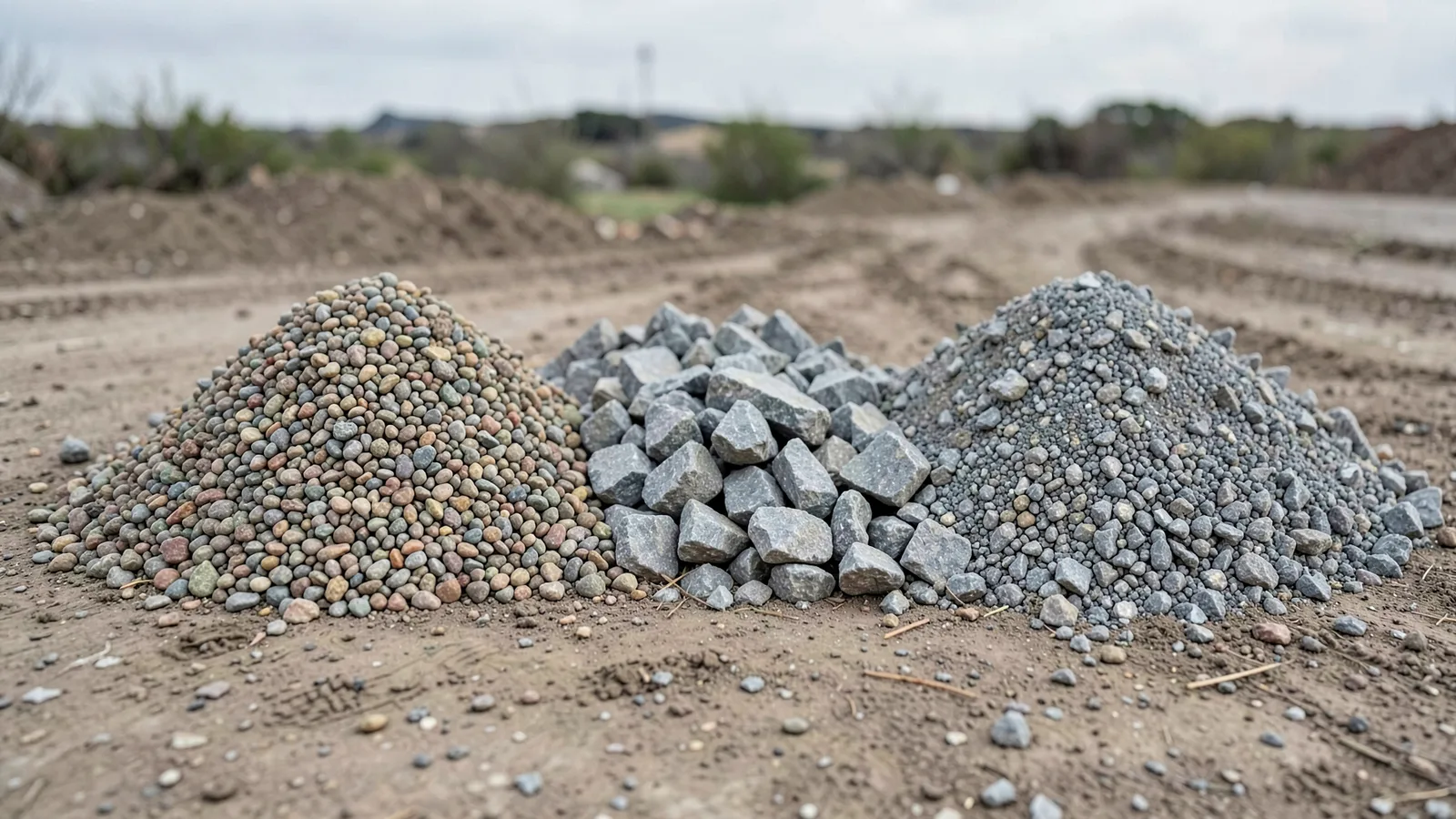
The difference is one word: angular or rounded. Everything else follows from it.
Crushed stone is fractured rock with sharp faces that lock together under load. Pea gravel is naturally rounded river stone with no faces to interlock, so the pieces roll past each other. That single property decides where each one belongs.
Side by side
| Pea gravel | Crushed stone (#57) | |
|---|---|---|
| Shape | Rounded, ⅜ in | Angular, ¾ in |
| Interlocks under load | No | Yes |
| Cost per ton | $40 – $80 | $30 – $60 |
| Weight per cu yd | ~1.42 tons | ~1.35 tons |
| Compacts | No | Somewhat |
| Comfortable barefoot | Yes | No |
| Stays in place | Poorly — needs edging | Well |
| Drainage | Excellent | Excellent |
| Best use | Patios, paths, play areas | Driveways, bases, drains |
Gravel Calculator
Work out how many cubic yards or tons of gravel you need for a driveway, path or drainage bed — with the density for each aggregate type shown in full.
Where each one wins
Pea gravel is the nicer surface to be on. It is smooth underfoot, comfortable in bare feet, and looks softer in a garden setting. Under a patio table, around a fire pit, in a play area or on a path people walk barefoot, it is clearly the better choice.
Its weakness is that it will not stay put. Rounded stone flows — it spreads sideways under any load, forms ruts where wheels turn, and migrates out of unbordered areas over a season. Every pea gravel installation needs an edge restraint, and it still needs raking back into place periodically.
Crushed stone is the functional choice. The angular faces wedge against each other under load, so the surface knits together and holds its shape. It handles vehicle traffic, it can be compacted into a stable base, and it stays inside its boundaries with far less intervention.
Its weakness is that it is unpleasant to walk on barefoot and it looks industrial rather than decorative. Nobody chooses crushed stone for how it looks.
Use both, in layers
The best gravel driveways use crushed stone throughout: a compacted crusher-run base with a #57 stone surface. Where you want the look and feel of pea gravel on a patio or path, it still belongs over a compacted crushed-stone base — the base does the structural work and the pea gravel is only the wearing surface.
The migration problem
This is the thing people underestimate. On a driveway, pea gravel does not wear out — it leaves. Turning wheels push it outward, snow clearing scrapes it into the lawn, and rain moves it downhill. Expect to top up and regrade a pea gravel driveway roughly twice as often as a crushed stone one.
If you like the look of rounded stone but need a driveway, the usual compromise is a crushed-stone driveway with pea gravel borders and beds — the traffic surface stays put, and the decorative stone sits where nothing drives on it.
Cost over five years
For a 400 sq ft area at 3 inches, including topping up:
| Pea gravel | Crushed stone | |
|---|---|---|
| Initial material | ~$220 | ~$160 |
| Edging (needed for pea gravel) | ~$150 | optional |
| Topping up over 5 years | ~$200 | ~$100 |
| Five-year total | ~$570 | ~$260 |
The gap is not really about the price per ton. It is that rounded stone needs containing and replacing more often.
Which to choose
Choose pea gravel if the surface is for people rather than vehicles, comfort underfoot matters, and the area has a solid edge to hold it in.
Choose crushed stone if anything drives on it, it needs to be compacted, it is a base for something else, or you would rather not maintain it every season.
Choose decomposed granite instead if you want a path that is firm and walkable but still looks natural — it compacts into a solid surface and does not migrate the way pea gravel does.
Common questions
Can you use pea gravel for a driveway?
You can, but it will spread. Rounded stone does not interlock, so it migrates under turning wheels and needs a firm edge restraint plus regular raking. Angular crushed stone locks together and stays put, which is why it is the standard driveway surface.
Which is cheaper, pea gravel or crushed stone?
Crushed stone, usually by a third. Crushed stone #57 runs $30 to $60 per ton against $40 to $80 for pea gravel, because pea gravel is screened and washed for appearance.
Is pea gravel good for drainage?
Yes, rounded stone drains well because the voids between the pieces stay open. For a French drain, though, washed angular #57 stone is the standard choice — it drains as well and does not shift when backfilled.
Calculators for this
- Gravel Calculator
Work out how many cubic yards or tons of gravel you need for a driveway, path or drainage bed — with the density for each aggregate type shown in full.
Part of our driveways guide.
Reviewed by Quban, Construction estimator, on . How these numbers are checked.