Guides
How much gravel do I need?
Work out gravel in cubic yards and tons from your area and depth, with the coverage shortcut, recommended depths, and why compaction changes the order.
Updated
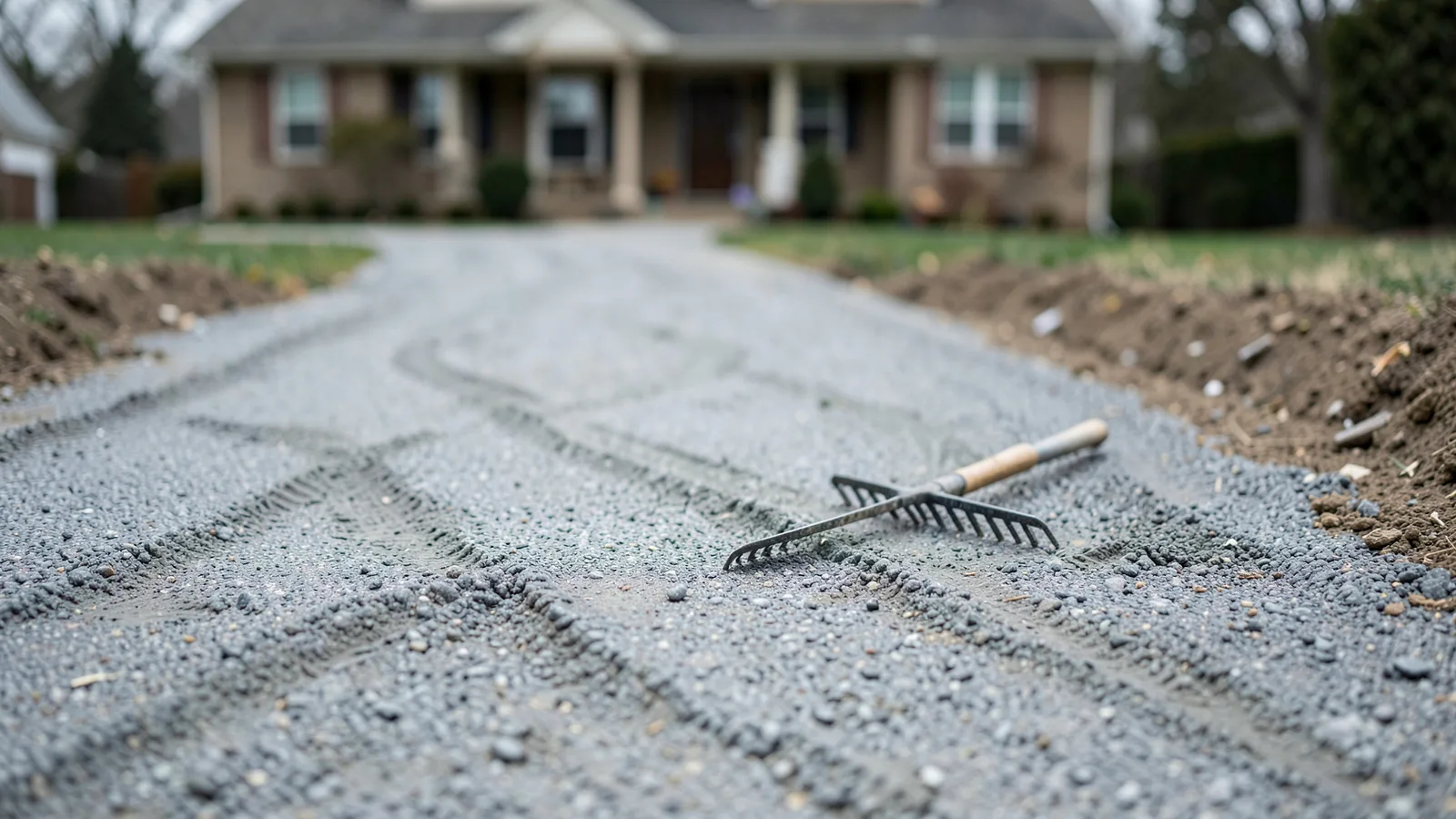
The quickest version: one cubic yard of gravel covers 81 square feet at 4 inches deep, and weighs about 1.35 tons. Divide your square footage by 81 and you have your cubic yards for a driveway-depth layer.
That shortcut assumes crushed stone at about 100 lb per cubic foot. Decorative stone, lava rock and compacted base material all behave differently, which is what the calculator is for.
Gravel Calculator
Work out how many cubic yards or tons of gravel you need for a driveway, path or drainage bed — with the density for each aggregate type shown in full.
The arithmetic, step by step
For a 30 ft × 12 ft driveway at 4 inches:
- Area — 30 × 12 = 360 sq ft
- Depth in feet — 4 ÷ 12 = 0.333 ft
- Volume — 360 × 0.333 = 120 cu ft
- Waste — 120 × 1.10 = 132 cu ft
- Cubic yards — 132 ÷ 27 = 4.89 cu yd
- Tons — 132 × 100 ÷ 2,000 = 6.6 tons
The 27 comes up in every gravel calculation because there are 27 cubic feet in a cubic yard. If you remember one number, make it that one.
How deep should it be?
Depth matters more than area for whether the job works. Too shallow and the ground shows through and weeds come up; too deep in a single layer and a compactor cannot reach the bottom of it.
| Use | Depth | Material |
|---|---|---|
| Garden bed, instead of mulch | 2–3 in | Pea gravel, river rock |
| Walkway or path | 2–3 in | Decomposed granite, pea gravel |
| Patio base under pavers | 4–6 in | Crusher run, compacted |
| Driveway surface | 3–4 in | Crushed stone #57 |
| Driveway base | 4–6 in | Crusher run, compacted |
| French drain | 6–12 in | Washed #57 stone |
A gravel driveway built properly is two layers, not one: a compacted crusher-run base with a crushed-stone surface over it. Ordering a single deep layer of decorative stone is the most common way to end up with a driveway that ruts within a year.
Compacted layers need extra material
Dense-graded base loses roughly a fifth of its loose volume when it is rolled. If your layer is going to be compacted, order about 20% more than the finished volume — otherwise the depth comes up short after the first pass with the plate compactor.
Coverage per cubic yard
| Depth | Coverage per cubic yard |
|---|---|
| 1 in | 324 sq ft |
| 2 in | 162 sq ft |
| 3 in | 108 sq ft |
| 4 in | 81 sq ft |
| 6 in | 54 sq ft |
Yards or tons?
Suppliers quote both, and the two are not interchangeable without knowing the density. For ordinary crushed stone, one cubic yard is about 1.35 tons — but lava rock is nearer 0.6 tons per cubic yard, so the same tonnage covers more than twice the ground.
Always ask which unit a quote is in before comparing two of them. A price "per yard" that turns out to be per ton is a 35% difference.
How much extra to order
Ten percent is the standard allowance, and unlike asphalt there is no downside to a small overage — gravel keeps indefinitely and you will find a use for the remainder. Push it higher when:
- the ground is uneven, so the depth varies across the area
- you are spreading by hand rather than having it tipped in place
- the area has many edges or curves where material spills
- the surface will settle, which every new gravel layer does in its first season
Common questions
How much gravel do I need for a 20x20 area?
A 20 ft × 20 ft area is 400 sq ft. At 4 inches deep that is about 5.4 cubic yards including a 10% waste allowance, or roughly 7.3 tons of crushed stone.
How many square feet does a ton of gravel cover?
About 120 square feet at 2 inches deep, 60 square feet at 4 inches, or 40 square feet at 6 inches, for crushed stone at 100 lb per cubic foot. Lighter decorative stone covers considerably more.
Is gravel sold by the yard or by the ton?
Both, depending on the supplier. Landscape suppliers usually quote cubic yards; quarries and bulk haulers usually quote tons. One cubic yard of crushed stone is about 1.35 tons, so it is worth converting before comparing two quotes.
Calculators for this
- Gravel Calculator
Work out how many cubic yards or tons of gravel you need for a driveway, path or drainage bed — with the density for each aggregate type shown in full.
Part of our driveways guide.
Reviewed by Quban, Construction estimator, on . How these numbers are checked.