Guides
Types of gravel for driveways
Which aggregate belongs in each layer of a driveway — base, middle and surface — and which decorative stones fail under vehicle traffic.
Updated
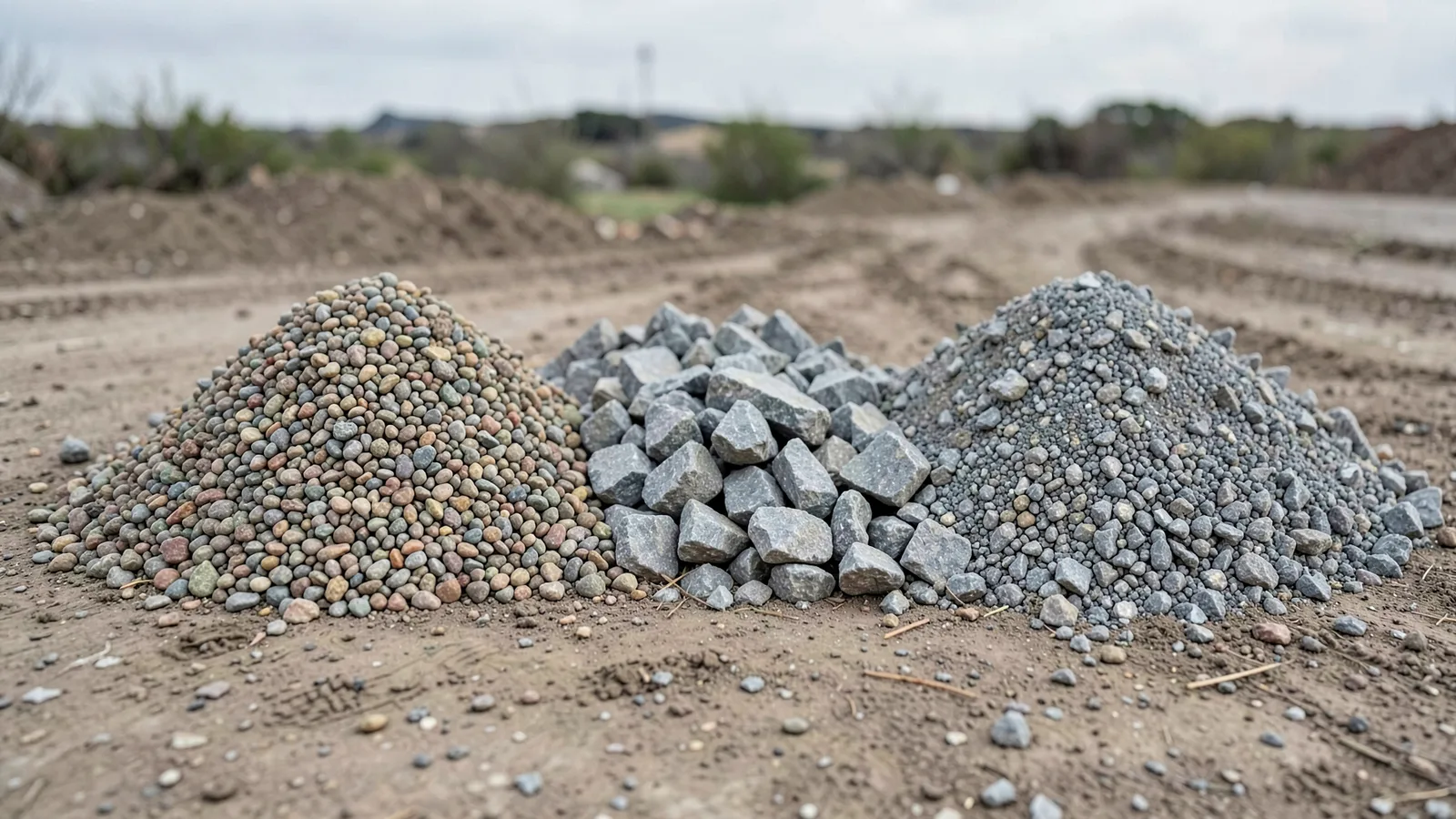
Most failed gravel driveways fail for the same reason: one layer of the wrong stone. A driveway is a layered structure, and each layer has a different job that a different aggregate does best.
Decorative rounded stone spread straight onto graded soil looks right for about a season, then ruts, migrates and sinks. The fix is not more of it.
Gravel Calculator
Work out how many cubic yards or tons of gravel you need for a driveway, path or drainage bed — with the density for each aggregate type shown in full.
The layers, from the bottom up
| Layer | Depth | Material | Job |
|---|---|---|---|
| Sub-base (soft ground only) | 4–8 in | #3 or #4 stone, 2–3 in | Bridges soft soil, drains |
| Base | 4–6 in | Crusher run / dense grade | Compacts solid, carries the load |
| Surface | 3–4 in | Crushed stone #57 | Wears, sheds water, stays put |
On firm, well-drained ground the sub-base can be skipped. On clay, or anywhere that stays wet, it is what stops the drive disappearing into the soil — with geotextile fabric underneath it to keep the stone and the mud separate.
The aggregates
Crusher run — the base layer
Also sold as dense grade, QP, or "crush and run". A mixture of angular stone and fines, and the fines are the point: they fill the voids between the stones so the layer compacts into something close to a solid slab.
- Use it for: the base under any driveway surface
- Do not use it for: the top layer — the fines turn to mud in rain and dust in summer
- Density: about 105 lb/ft³, and it compacts about 22 percent
Crushed stone #57 — the surface layer
Three-quarter inch angular stone with the fines screened out. The angular faces wedge against each other under load, so the surface knits together and holds its shape. Because there are no fines, water passes straight through it.
- Use it for: the driveway surface, and for drainage beds
- Density: about 100 lb/ft³, not compacted
- The default answer for "what gravel goes on top"
Crushed limestone — a regional alternative
Where limestone is quarried locally it is often the cheapest option and performs much like #57. It contains more fines than washed stone, so it packs down harder — good for firmness, slightly worse for drainage. It also produces a pale dust that shows on cars.
Pea gravel — not for driveways
Rounded ⅜ inch stone. Comfortable underfoot and attractive, but rounded stone does not interlock, so it flows under turning wheels, forms ruts and migrates out of any unbordered area.
- Use it for: patios, paths, play areas, borders
- Do not use it for: a driveway surface, unless you accept regular raking and a firm edge restraint
River rock — decorative only
Larger rounded stone, 1 to 3 inches, sold on appearance. Everything true of pea gravel is more true here: it will not compact, it will not stay put, and it is uncomfortable to walk on. It belongs in beds and dry creek features, not under wheels.
Decomposed granite — for paths, sometimes drives
Fine granite screenings that compact into a firm, walkable surface. Excellent for paths and patios. It works on a low-traffic drive but erodes in heavy rain unless stabilised, and it tracks into the house.
Lava rock — landscape only
Very light volcanic stone, around 45 lb/ft³ — under half the weight of crushed stone. It has no place on a driveway; it crushes under vehicles and floats away in heavy rain.
Angular or rounded is the whole decision
If you remember one thing: angular stone locks, rounded stone rolls. Any aggregate described as crushed will stay where you put it. Anything described as pea, river, or rounded will not, no matter how deep you spread it.
Quick comparison
| Material | Shape | Driveway surface | Base | Density lb/ft³ |
|---|---|---|---|---|
| Crusher run | Angular + fines | No | Yes | 105 |
| Crushed stone #57 | Angular | Yes | Drainage only | 100 |
| Crushed limestone | Angular | Yes | Yes | 100 |
| Decomposed granite | Fine angular | Light use | No | 110 |
| Pea gravel | Rounded | No | No | 105 |
| River rock | Rounded | No | No | 105 |
| Lava rock | Rounded, porous | No | No | 45 |
Ordering the right amounts
A 30 ft × 12 ft driveway (360 sq ft) built properly:
- Base: 4 in of crusher run, compacted → about 6 cubic yards ordered loose
- Surface: 3 in of #57 → about 3.7 cubic yards
That is two separate deliveries of two different materials, and it is why a driveway quoted as a single load of stone is not a driveway that will last.
What to ask the supplier
- Is this angular or rounded? The single most important question
- Does it contain fines? Fines are wanted in the base, unwanted on the surface
- What is the density? So the tonnage calculation matches their product
- Is it washed? Washed stone drains better; unwashed packs harder
- Yards or tons? The two differ by about 35 percent for crushed stone
Common questions
What is the best gravel for a driveway?
Crushed stone #57 over a compacted crusher-run base. The angular #57 locks together under traffic while the crusher run beneath it compacts into a solid load-bearing layer. A single layer of decorative rounded stone is the most common mistake.
What size gravel is best for a driveway?
Three-quarter inch angular stone for the surface, and a dense-graded mix with fines for the base. Larger stone will not lock together and stays loose underfoot; smaller stone without fines migrates too easily under turning wheels.
How many layers should a gravel driveway have?
Two at minimum — a 4 to 6 inch compacted crusher-run base and a 3 to 4 inch #57 stone surface. Over soft clay a third layer of larger 2 to 3 inch stone underneath, with geotextile fabric below it, stops the drive sinking.
Calculators for this
- Gravel Calculator
Work out how many cubic yards or tons of gravel you need for a driveway, path or drainage bed — with the density for each aggregate type shown in full.
Part of our driveways guide.
Reviewed by Quban, Construction estimator, on . How these numbers are checked.