Comparisons
Gravel vs asphalt driveway
Cost, lifespan, maintenance and climate compared — when a gravel driveway is the right answer and when paving pays for itself.
Updated
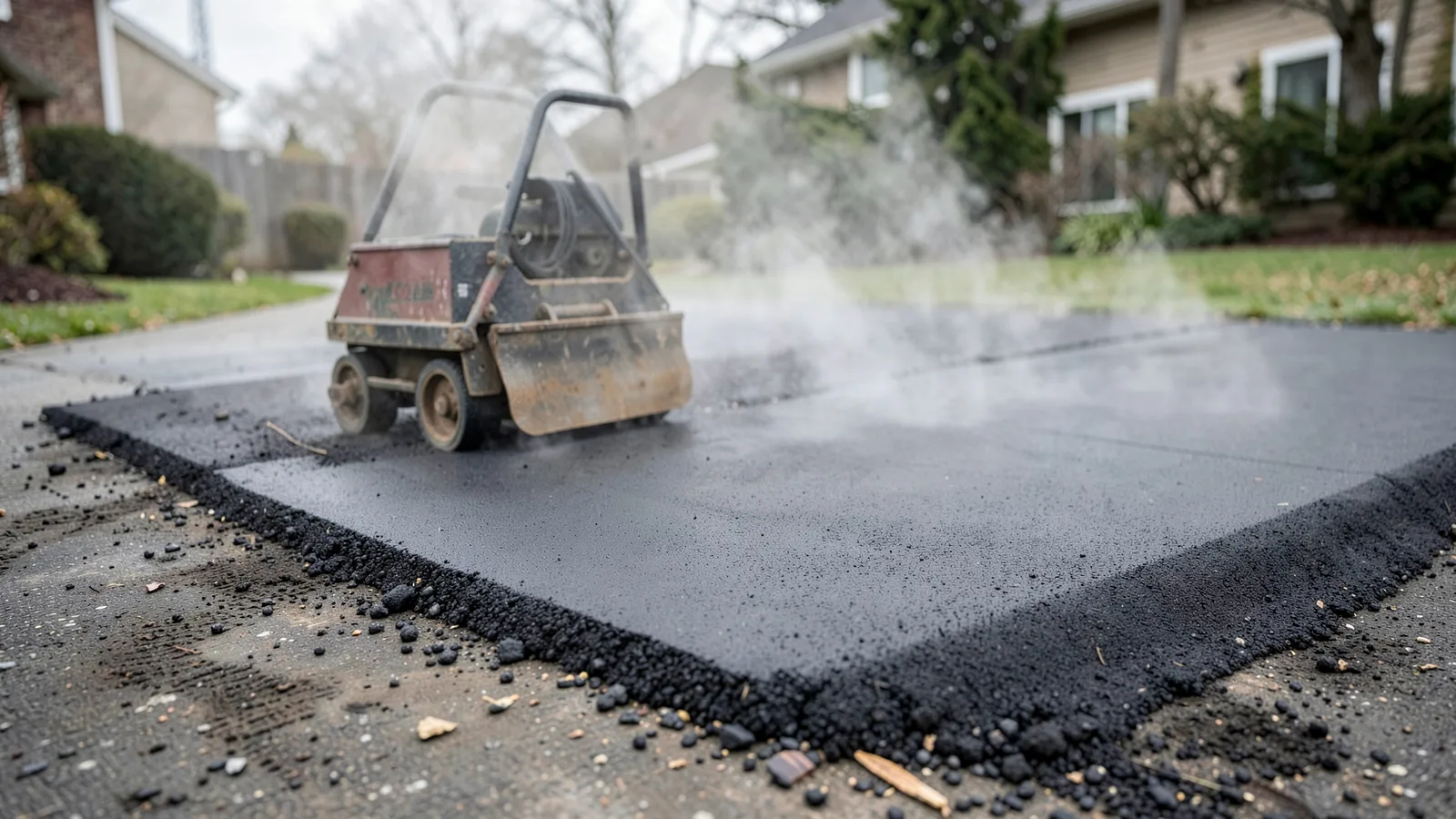
The honest summary: gravel wins on cost and on long driveways; asphalt wins on everything else. The decision usually comes down to how long the drive is and how much annual maintenance you are willing to do.
Gravel is the only driveway surface most people can install and maintain themselves. Asphalt is a finished surface that asks nothing of you for a few years at a time.
Side by side
| Gravel | Asphalt | |
|---|---|---|
| Installed cost | $1–$5 /sq ft | $4–$8 /sq ft |
| Lifespan | 10–20 yrs with topping up | 15–25 yrs |
| DIY realistic | Yes | No |
| Maintenance | Regrade and top up yearly | Seal every 3–5 yrs |
| Usable after install | Immediately | 24 hours |
| Snow clearing | Takes material with it | Clean |
| Weeds | Ongoing without fabric | None |
| Mud and dust | Yes, in wet and dry spells | No |
| Drainage | Permeable | Runs off |
| Repairable in sections | Yes, with a shovel | Needs a crew |
| Resale impression | Utilitarian | Finished |
Gravel Calculator
Work out how many cubic yards or tons of gravel you need for a driveway, path or drainage bed — with the density for each aggregate type shown in full.
Cost over twenty years
For a 600 square foot driveway. Both figures assume the maintenance actually gets done.
| Gravel | Asphalt | |
|---|---|---|
| Installation | $1,500 | $3,600 |
| Topping up (10× at $120) | $1,200 | — |
| Sealing (5× at $150) | — | $750 |
| Resurfacing at ~18 years | — | $1,800 |
| Twenty-year total | ~$2,700 | ~$6,150 |
Gravel stays cheaper over the full period, which is not true of the asphalt-versus-concrete comparison. The catch is that gravel's cost is spread across your own weekends as well as your money.
Where each one wins
Gravel wins on length. Paving cost scales linearly with area, so the longer the drive the more decisively gravel wins. At 500 feet the difference is tens of thousands of dollars, and a rural drive at that length is rarely worth paving.
It also wins on drainage and permeability. Water passes through gravel instead of running off toward the house or the street, which matters where stormwater rules limit impervious area. Some jurisdictions now require permeable surfacing above a certain paved footprint.
And it wins on repairability. A pothole in gravel is fixed with a shovel and a bag of stone. A pothole in asphalt needs hot mix and a crew, or it gets a cold patch that fails within a season.
Asphalt wins on everything to do with living with it. No mud in spring, no dust in summer, no weeds, no ruts, and snow clears off it cleanly rather than taking half your driveway into the lawn. It is a finished surface, and it reads that way.
It also wins where the driveway slopes. Gravel migrates downhill under rain and traffic, and above roughly a 10 percent grade it becomes a losing battle.
Gravel is not a wasted investment if you pave later
A properly compacted gravel driveway is close to the aggregate base an asphalt driveway needs underneath it. Building in gravel now and paving in five years means the base is already there, already compacted, and already settled — which is genuinely the best sequence if the budget is the only thing stopping you paving today.
The maintenance difference
This is what people underestimate, in both directions.
Gravel needs attention every year or two: regrading to fill ruts and restore the crown, and a ton or two of new stone to replace what snow clearing and rain carried away. It is an afternoon with a rake for a small drive, or an hour with a tractor box blade for a long one. Skip it for a few years and you get potholes that hold water, which accelerates everything.
Asphalt needs almost nothing for the first three years, then sealing every three to five. Crack filling matters more than sealing does — water reaching the base is what actually destroys an asphalt driveway, and a $20 tube of crack filler is the cheapest maintenance in this article.
Climate
Freeze-thaw favours asphalt slightly. Gravel is unaffected by frost heave — it simply moves and settles back — but snow clearing is where gravel suffers, and a plough on a gravel drive removes stone every pass. A rubber-edged blade or a raised skid helps.
Wet climates favour gravel for drainage but punish it for mud. A gravel drive over clay with no geotextile fabric turns into a rutted mess; with fabric and a proper base it stays firm.
Dry, dusty climates favour asphalt. Gravel generates dust with every vehicle, which is a genuine nuisance close to a house.
Which to choose
Choose gravel if the drive is long, the budget is tight, you can do the maintenance yourself, drainage or permeability matters, or you may pave later.
Choose asphalt if the drive is short enough that paving is affordable, you want a finished surface with no annual work, you clear snow with a plough, or the drive slopes more than about 10 percent.
Do both, in order, if the only obstacle is budget. Build the gravel base properly now, live on it, and pave over it when you can — nothing is wasted.
Common questions
Is a gravel driveway cheaper than asphalt?
Yes, by roughly half to two-thirds up front — about $2.50 per square foot against $6 for asphalt. Over twenty years the gap narrows to around 30 percent once gravel's annual topping up and regrading are counted.
Can you put asphalt over an existing gravel driveway?
Often yes, and it is one of gravel's real advantages. A well-compacted gravel driveway is close to the aggregate base an asphalt driveway needs anyway. It has to be properly graded and compacted first, but the material is not wasted.
Which is better for a long rural driveway?
Gravel, almost always. Paving cost scales directly with length, so a 500 foot drive that costs $12,000 in gravel costs $30,000 or more in asphalt. Gravel is also repairable in sections with a shovel rather than a crew.
Calculators for this
- Gravel Calculator
Work out how many cubic yards or tons of gravel you need for a driveway, path or drainage bed — with the density for each aggregate type shown in full.
- Asphalt Calculator
Work out how many tons of asphalt your driveway or lot needs, from its dimensions and compacted thickness — with the density and formula shown in full.
Part of our driveways guide.
Reviewed by Quban, Construction estimator, on . How these numbers are checked.