Reference
Board foot chart
Board feet per board by thickness and width, hardwood quarter thicknesses before and after surfacing, and nominal against actual softwood sizes in one place.
Updated
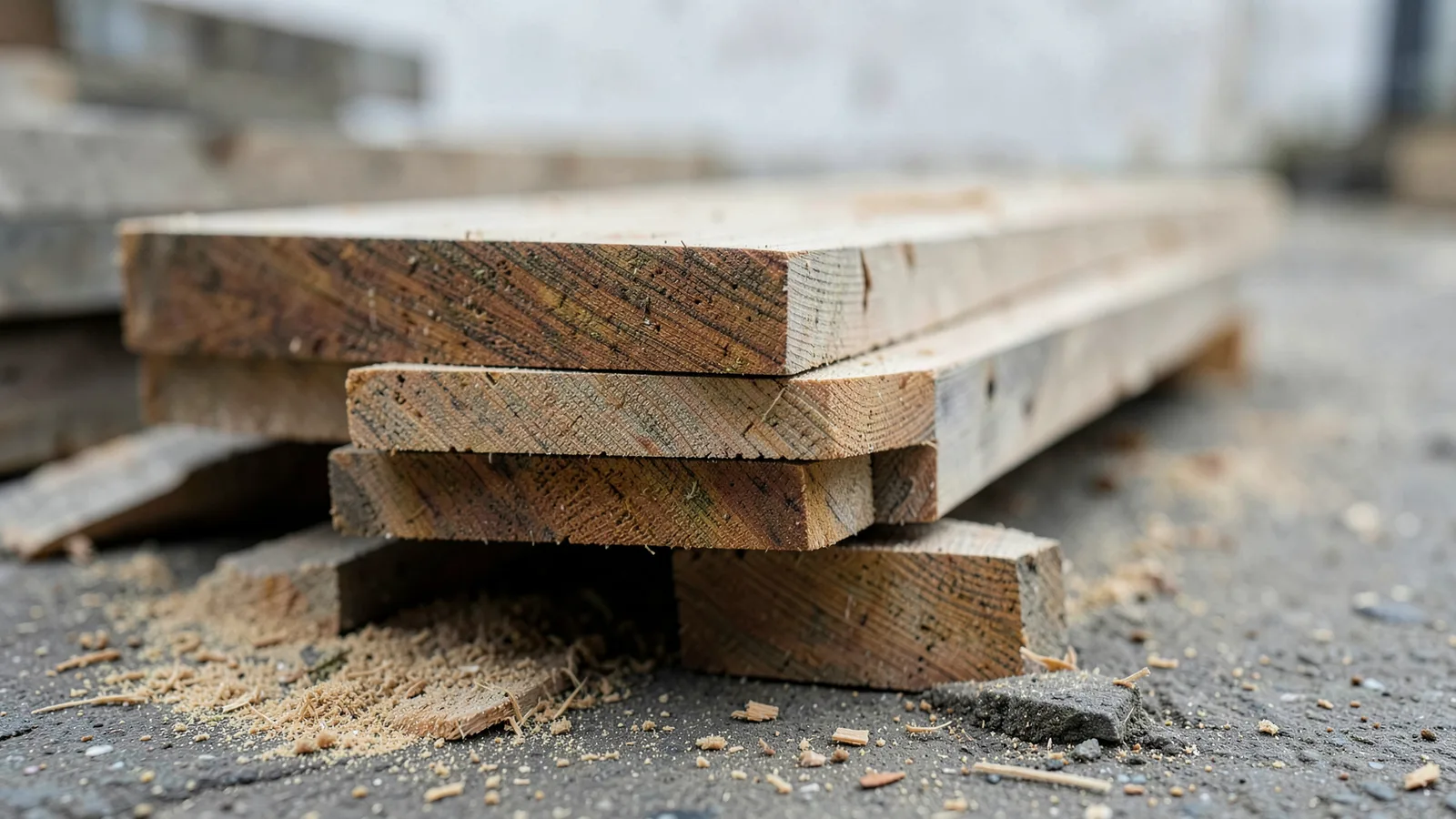
Everything on this page is a lookup. The formula behind all of it is thickness × width × length ÷ 144 with all three in inches, or ÷ 12 if the length is in feet.
Board Foot Calculator
Work out board feet for hardwood from thickness, width and length — including why 4/4 stock is billed as one inch and arrives at thirteen sixteenths.
Board feet per board
For an 8 ft board, by thickness and width:
| Thickness | 4 in | 6 in | 8 in | 10 in | 12 in |
|---|---|---|---|---|---|
| 4/4 | 2.67 | 4.00 | 5.33 | 6.67 | 8.00 |
| 5/4 | 3.33 | 5.00 | 6.67 | 8.33 | 10.00 |
| 6/4 | 4.00 | 6.00 | 8.00 | 10.00 | 12.00 |
| 8/4 | 5.33 | 8.00 | 10.67 | 13.33 | 16.00 |
For other lengths, scale proportionally: a 6 ft board is three-quarters of these figures, a 10 ft board a quarter more.
Hardwood thicknesses
Quoted in quarters of an inch of rough stock. You are billed on the rough figure and receive the surfaced one.
| Quoted | Rough | Surfaced | Typical use |
|---|---|---|---|
| 4/4 | 1 in | 13/16 in | Cabinet and furniture panels, shelving |
| 5/4 | 1 1/4 in | 1 1/16 in | Stair treads, worktops, heavy shelving |
| 6/4 | 1 1/2 in | 1 5/16 in | Table aprons, thick edging |
| 8/4 | 2 in | 1 3/4 in | Table and chair legs, thick tops |
| 10/4 | 2 1/2 in | 2 1/4 in | Heavy legs, structural furniture parts |
| 12/4 | 3 in | 2 3/4 in | Turning stock, workbench tops |
| 16/4 | 4 in | 3 3/4 in | Large turnings, timber components |
The difference between the two columns became shavings at the mill. This is standard practice across the hardwood trade rather than a supplier being sharp — if you would rather keep the thickness, buy rough and mill it yourself.
Softwood: nominal against actual
Framing lumber is sold by the piece at nominal sizes that have not matched actual dimensions since the 1960s.
| Nominal | Actual | Common use |
|---|---|---|
| 1×4 | 3/4 × 3 1/2 in | Trim, furring, battens |
| 1×6 | 3/4 × 5 1/2 in | Trim, fascia, shelving |
| 2×4 | 1 1/2 × 3 1/2 in | Partitions, most exterior walls |
| 2×6 | 1 1/2 × 5 1/2 in | Exterior walls, 24 in framing, rafters |
| 2×8 | 1 1/2 × 7 1/4 in | Headers, joists, rafters |
| 2×10 | 1 1/2 × 9 1/4 in | Headers, joists, stair stringers |
| 2×12 | 1 1/2 × 11 1/4 in | Long-span headers, stringers |
| 4×4 | 3 1/2 × 3 1/2 in | Posts |
| 6×6 | 5 1/2 × 5 1/2 in | Structural posts, timber framing |
Where this bites hardest is anywhere two materials meet flush — a 2×4 wall with half-inch drywall each side finishes at 4½ inches, not 5, and every door jamb depends on knowing it.
Hardwood grades and what they yield
| Grade | Clear yield | Typical waste | Best for |
|---|---|---|---|
| FAS | 83% | 20% | Long clear rails, wide panels |
| Select | 83% | 25% | Work where only one face shows |
| No. 1 Common | 66% | 35% | Cabinet parts, shorter components |
| No. 2 Common | 50% | 45% | Small parts, painted work |
The cheapest grade per board foot is not always the cheapest project. For small components No. 1 Common is excellent value; for long clear stock the extra waste can cost more than the grade saved.
Thirty percent waste is normal for hardwood
Boards arrive in random widths and lengths rather than dimensioned sizes, defects have to be cut around, and every jointed edge loses stock. Thirty percent on FAS is a genuine allowance, not padding — and the common grades need considerably more.
Quick conversions
- Board foot = 144 cubic inches = 1 in × 12 in × 12 in
- Board feet from feet = Thickness (in) × Width (in) × Length (ft) ÷ 12
- Board feet in a 1×12 = one per linear foot — the easiest sanity check there is
- Cubic foot = 12 board feet
Related
Common questions
How many board feet are in a 1x8x8 board?
5.33 board feet. The arithmetic is 1 inch times 8 inches times 96 inches divided by 144, which is 5.33. The same board in 8/4 stock would be double that at 10.67.
What is a board foot?
A volume of 144 cubic inches — one inch thick by twelve inches square. It is how hardwood is priced, unlike softwood framing which is sold by the piece at nominal sizes.
Is a board foot the same as a linear foot?
No. A linear foot is a length whatever the board's size; a board foot is a volume. A 1x12 gives one board foot per linear foot and a 1x6 gives half, so comparing prices across the two units means nothing without the dimensions.
What does 5/4 mean in lumber?
Five quarters of an inch — nominally one and a quarter inches thick in the rough, arriving at about 1 1/16 inches once surfaced. Hardwood thickness is always quoted in quarter-inches of rough stock.
Calculators for this
- Board Foot Calculator
Work out board feet for hardwood from thickness, width and length — including why 4/4 stock is billed as one inch and arrives at thirteen sixteenths.
- Stud Calculator
Count studs for a wall at 12, 16 or 24 inch centres — including the corners, intersections and the kings and jacks at every opening.
Part of our framing guide.
Reviewed by Quban, Construction estimator, on . How these numbers are checked.