Guides
How deep should gravel be?
Depths for driveways, paths, patios and drainage, why the base matters more than the surface, and the six-inch limit on what a roller can actually compact.
Updated
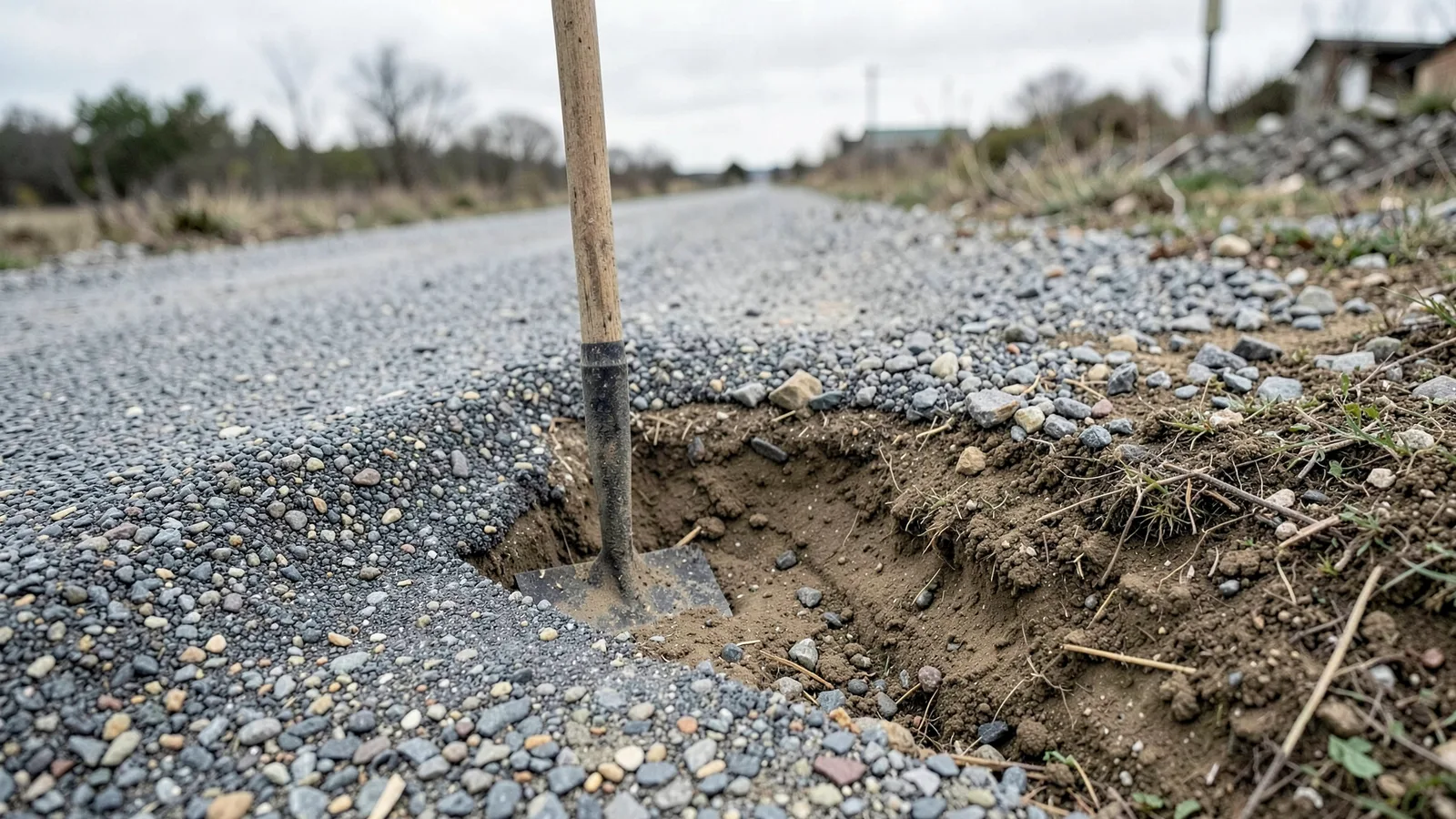
Depth is not one number. It depends on what is going on top of the gravel and what is underneath it — and the layer that decides whether the job lasts is usually the one you cannot see.
Gravel Calculator
Work out how many cubic yards or tons of gravel you need for a driveway, path or drainage bed — with the density for each aggregate type shown in full.
Depths at a glance
| Use | Surface depth | Base beneath | Total |
|---|---|---|---|
| Footpath | 2–3 in | 2–4 in | 4–7 in |
| Patio or seating area | 2–3 in | 4 in | 6–7 in |
| Car driveway | 4–6 in | 4–6 in | 8–12 in |
| Truck or RV access | 4–6 in | 8–12 in | 12–18 in |
| Drainage bed | 12+ in | — | 12+ in |
| Shed or slab base | — | 4–6 in | 4–6 in |
The right-hand column is what you excavate to. The left is what most people mean when they say "how deep should the gravel be", and on its own it is not enough to build from.
Below two inches, gravel does not work
At less than about two inches you can still see soil between the stones. Weeds come straight through, the surface scatters underfoot, and the whole thing looks tired within a season. Two inches is the practical floor for anything decorative, and three is better on a path that gets real use.
The base does the structural work
Almost every driveway failure is a base failure, not a surface failure. Under whatever you can see there should be a compacted aggregate base — typically 4 to 6 inches for cars, 8 to 12 where trucks turn or the subgrade is soft clay. The base spreads the wheel load and, in cold climates, gives water somewhere to go before it freezes and lifts the surface.
This has a practical consequence for ordering: a gravel driveway is usually two materials, not one. A dense-graded base such as crusher run underneath, which locks together when rolled, and a cleaner angular stone on top. They have different densities and different depths, and they are calculated separately.
Compact in layers, not in one pass
A roller only compacts about six inches of material at a time. Spread twelve inches in one lift and the bottom half stays loose no matter how many passes you make — it will settle over the first winter and take the surface down with it. Two six-inch lifts, each compacted, is the difference between a drive that holds and one that develops ruts.
Compaction changes what you order
Base material is bought loose and ends up compacted, so the volume you order has to exceed the finished layer. Dense-graded base loses roughly a fifth of its loose volume when rolled; decomposed granite and crushed limestone are similar. Decorative gravels that are never compacted do not need the allowance at all.
| Material | Compaction allowance |
|---|---|
| Crusher run / dense grade base | +22% |
| Crushed limestone | +20% |
| Decomposed granite | +18% |
| Crushed stone (#57) | none — it is not compacted |
| Pea gravel, river rock | none |
Drainage depth is a different question
A French drain or a soakaway is not sized by appearance but by how much water it has to hold. Twelve inches is a starting point, and the void space between the stones — roughly a third of the volume for clean angular stone — is what does the work. Use clean stone with no fines: a dense-graded base compacted into a drainage trench is a trench that does not drain.
Fall matters as much as depth
A driveway should fall about one to two percent away from the house — roughly a quarter-inch per foot. A flat gravel drive ponds, and ponded water is what destroys the base regardless of how deep you built it.
Related
Common questions
How deep should gravel be for a driveway?
Four to six inches of surface stone over a compacted base, and more base where trucks turn or the subgrade is soft clay. A new driveway built from scratch typically wants 8 to 12 inches total across two or three layers.
How deep should gravel be for a path?
Two to three inches over a weed barrier. Below about two inches you can still see soil between the stones and weeds come straight through, which is the most common reason a gravel path looks tired within a season.
Can I put gravel down in one thick layer?
Not if it is being compacted. A roller only compacts about six inches at a time, so a thicker lift stays loose at the bottom and the surface settles unevenly later. Spread and compact in layers instead.
Does gravel depth include the base?
No, and conflating them is the usual reason a driveway fails. The surface layer is what you see; the compacted aggregate base underneath spreads the load and drains water, and it does most of the structural work.
Calculators for this
- Gravel Calculator
Work out how many cubic yards or tons of gravel you need for a driveway, path or drainage bed — with the density for each aggregate type shown in full.
Part of our driveways guide.
Reviewed by Quban, Construction estimator, on . How these numbers are checked.